 Uniswap
 liquidity pools turn reserve balances into executable swap prices
Uniswap liquidity pools enable swaps by holding two assets and applying a pricing function to their changing balances. When a trader adds one asset and removes the other, the contract computes an output, charges the pool's configured fee, and commits both balance changes together. The resulting balances and pool state become the starting point for the next swap.
Updated ·
That mechanism varies across protocol versions. Uniswap v2 exposes a full-range constant-product pool, while v3 and v4 divide concentrated liquidity across price ranges. Estimating a swap therefore requires the pool state, active liquidity, fee configuration, and caller limits.
Follow reserve state from quote to settlement
A pool calculation starts with a state snapshot and finishes when the transaction either commits a new state or leaves the prior state intact.
Readiness starts with the pool state
A quote reads the current price, reserve relationship, applicable fee, and available liquidity. In a concentrated-liquidity pool, it must also account for initialized ticks along the proposed price path. The quote does not reserve those conditions. Another swap can update the same state before the submitted transaction executes.
Execution recomputes the output
The contract uses the state available during execution, not a previously displayed figure. It applies the input amount, subtracts the portion used for the swap fee, and moves the price along the pool's curve. A concentrated-liquidity swap may activate or deactivate liquidity as it reaches position boundaries. Caller-supplied price or output limits determine whether the calculated result remains acceptable.
Settlement provides the observable result
A successful transaction records the asset deltas, fee accounting, and updated pool state together. If a required payment, price limit, or minimum output condition fails, the transaction reverts its pool changes. The transaction receipt and resulting balances provide stronger completion evidence than an interface estimate.
How does the constant-product curve set the output?
In Uniswap v2, the post-swap reserve product x × y must be at least as large as it was before the swap. A trader adds to one reserve and receives assets from the other. The curve selects an output preserving the invariant after accounting for the swap fee.
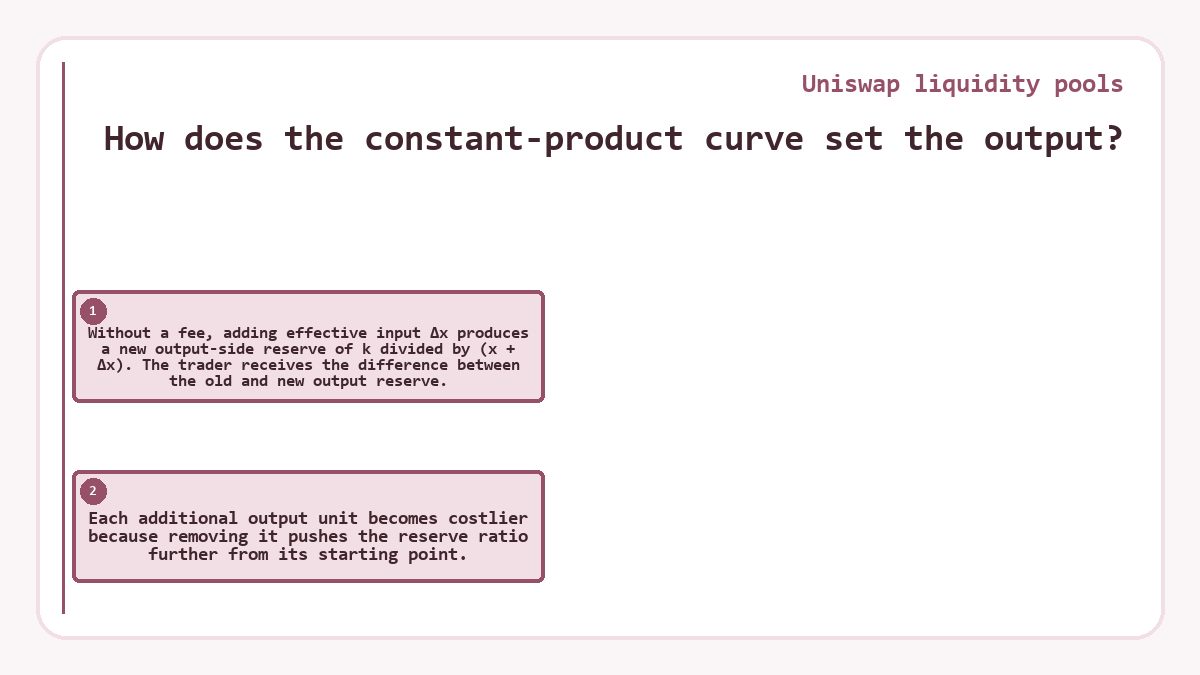
Without a fee, adding effective input Δx produces a new output-side reserve of k divided by (x + Δx). The trader receives the difference between the old and new output reserve. Each additional output unit becomes costlier because removing it pushes the reserve ratio further from its starting point.
Reserve depth controls price movement
Price impact depends on trade size relative to usable liquidity near the current price. A small input against deep liquidity changes the reserve relationship modestly. The same input against shallow liquidity moves further along the curve and receives a worse average rate. Total pool value alone can mislead because concentrated positions outside the current range do not support the swap.
Concentrated liquidity narrows the usable reserve range
Uniswap v3 and v4 let providers allocate liquidity within selected price intervals. The pool combines all positions covering the current price into its active liquidity.
Ranges supply local depth
A narrower in-range position can supply more depth around its chosen prices than the same capital spread across the full curve. The position also has boundaries. Once the price leaves them, its liquidity becomes inactive and stops earning swap fees. Its principal then consists of one pool asset, while previously accrued fees can include either asset.
Ticks change the active set
Ticks divide price space into discrete intervals and mark position boundaries. Within one interval, the swap follows the curve using the current active liquidity. Reaching an initialized tick changes the active amount by adding positions beginning there or removing positions ending there. The pool then continues with the revised depth.
What changes when a swap crosses a tick?
Crossing an initialized tick adds or removes the liquidity attached to positions whose boundary lies there. The price continues in the same direction, but the relationship between further input and price movement can become steeper or flatter. A large reduction in active liquidity makes the remaining portion of the swap move the price faster.
Tick crossing also adds computation because the contract updates tick and fee-growth records. An uninitialized tick does not change active liquidity. If active liquidity falls to zero, the core swap can advance the price through an empty interval to the next initialized tick without exchanging assets there. It cannot move past the caller's price limit.
Fees alter reserve and position accounting
Every swap applies the fee configured for its pool. In v2, the fixed 0.30% swap fee reduces the input used to calculate output, while the full input enters the reserves. This structure increases the reserve product. When the protocol fee is enabled, the pair later mints liquidity tokens to the fee recipient, so existing providers retain only the remaining fee value.
V3 and v4 track the liquidity-provider portion of swap fees as claimable amounts associated with positions rather than automatically adding it to position principal. Only liquidity active while the swap passes through a price interval earns the liquidity-provider portion. V4 can also use dynamic fee logic through a pool's hook, so a stored or displayed fee must match the pool configuration used for execution.
A hypothetical reserve update on the v2 curve
Assume a hypothetical no-fee pool holds 125 units of asset A and 205 units of asset B. Every quantity and the zero-fee condition in this example are hypothetical. The starting product is 25 625, which supplies the state needed to calculate a reserve change.
A hypothetical swap adds 5 units of asset A. The new A reserve is 130, so the curve sets the B reserve to 25 625 divided by 130, or about 197.12. The trader receives about 7.88 units of asset B. The successful transaction records reserves of 130 A and 197.12 B, subject to contract rounding.
An actual fee would reduce the effective input and therefore lower the output from this no-fee illustration. If pool state changes before execution, the contract calculates from the updated balances. A minimum output above the available amount causes a revert, leaving the earlier reserves intact even though the attempted transaction may consume a network fee. A fresh state read is then needed before another submission.
Can a pool run out of usable liquidity?
A pool can lose usable liquidity for a requested trade even while assets or inactive positions remain associated with it. In a v2-style full-range pool, the curve makes each remaining output unit increasingly expensive as its reserve approaches zero. Ordinary swaps therefore encounter extreme price movement before mathematically draining that reserve.
Concentrated-liquidity pools have a different boundary. A core swap can cross an empty interval to reach a later active range, but it cannot cross the caller's price limit. If it reaches that limit before producing enough output, surrounding router conditions can reject the result. Positions beyond the limit do not support that execution.
Pool versions store liquidity in different ways
The same reserve idea appears through different contract structures. Version, fee configuration, and active range determine which state controls the swap.
Uniswap v2 uses separate pair contracts
Each v2 pair contract holds two token reserves and applies the full-range constant-product relationship. Fungible liquidity tokens represent proportional claims on the pool. A reserve reading therefore describes the assets supporting the curve across its entire mathematical price range, although execution quality still changes sharply near either extreme.
Uniswap v3 combines range positions
Each v3 pool stores a current price, active liquidity, ticks, and fee-growth data. Individual positions contribute only inside their selected ranges. Raw token balances do not reveal how much liquidity supports the next price interval, so an accurate output calculation follows initialized ticks and their net liquidity changes.
Uniswap v4 centralizes pool accounting
V4 stores distinct pool states inside the PoolManager rather than deploying one contract for every pool. A pool's currencies, fee setting, tick spacing, and hook identify its behavior. Flash accounting tracks interim balance deltas and requires settlement before the operation finishes. A reserve total without the pool version, current price, fee, hook, and active liquidity cannot provide a complete execution forecast.
Uniswap liquidity pools: what people ask
Must liquidity providers always supply both pool assets?
No. A v2 position normally adds both assets in the pool's existing proportion. In v3 and v4, a range covering the current price generally requires both assets, while a range entirely above or below it can begin with one asset. The required composition follows the selected range and current pool price.
Can two Uniswap pools for the same asset pair return different outputs?
Yes. Pools can differ by protocol version, fee configuration, current price, and liquidity distribution. In v3, separate fee tiers identify distinct pools for the same assets. In v4, the fee setting, tick spacing, and hook are part of the pool's identity. A quote must use the exact pool state selected for the route rather than treating the pair name as sufficient.
Is price impact the same charge as a swap fee?
No. The swap fee is a configured deduction applied during the trade. Price impact is the change in execution rate caused by moving along the pool's curve. A trade can face both. Greater usable depth reduces price impact for a given amount, but it does not remove the configured fee.
What does a minimum-output setting protect during a pool swap?
A minimum output rejects execution when the pool calculation would deliver too little of the output asset. It protects against adverse state changes between quoting and execution, including intervening trades. It does not fix the pool price, cap the network fee, or guarantee the output asset's later market value.
Can an out-of-range liquidity position still be withdrawn?
Yes. Leaving the selected range makes a concentrated-liquidity position inactive; it does not transfer ownership or lock the position permanently. The owner can remove its liquidity under the applicable position controls. While out of range, the position stops earning swap fees, and its liquidity principal consists of one pool asset. Previously accrued fees can still include either asset.
Does a completed swap keep the pool's market value constant?
No. The invariant governs the mathematical relationship used by the contract, not a fixed value measured in another currency. A swap changes the quantities held, and external market prices can also change. Fees may increase the pool's assets, while arbitrage trades can move its reserve ratio toward prices available elsewhere.
Are liquidity-provider fees paid as a separate reward token?
Usually not. Swap fees arise in the assets traded by the pool. In v2, the liquidity-provider portion remains within reserve accounting and is reflected in liquidity shares. In v3 and v4, earned fees accumulate as claimable amounts associated with the position. Separate incentives, if any, are not part of the basic pool-fee mechanism.
Can another contract rely on a pool's current spot price?
A contract can read the pool state, but one instantaneous spot price is not inherently resistant to manipulation. A sufficiently large trade can move it for the surrounding transaction or block. Integrations needing an oracle commonly use time-weighted observations or additional safeguards, with the available method depending on the pool version and deployment.