 Uniswap
 price impact describes the trade's effect on its quoted rate, while minimum output sets the acceptance floor
Uniswap price impact compares the reference market price with the execution rate estimated for the proposed trade. The quoted output already reflects the selected route and its available liquidity at that moment. Minimum output serves a different purpose: it is the lowest output the execution may deliver before the transaction or order must reject the result. Market movement after the quote can push execution toward that bound, while the original price impact describes the trade's own effect.
Updated ·
The short version: For an exact-input pool swap, minimum output turns a quoted amount and slippage tolerance into the lowest execution result the swap will accept.
Read the quoted output, acceptance floor, and settled amount in order
An execution-quality check compares three figures with different roles.
The quoted output estimates how many output tokens the selected route is expected to return from the stated input. Price impact explains part of the gap between the reference market rate and that estimated execution rate. Maximum slippage then defines how far execution may deteriorate from the quote. For an exact-input pool swap, the resulting minimum output becomes a rejection boundary. These figures belong to one quote and should not be mixed with values from an earlier route.
After settlement, the delivered output shows what execution achieved. It should meet or exceed the bound attached to the submitted action. A reverted pool transaction delivers no swapped output because its token and pool-state changes do not commit. The transaction may still consume a network fee, so a failed result is not economically identical to never submitting it.
Quoted rate and market reference answer different questions
The quoted rate answers, "What average exchange rate does this route estimate for my full input?" Divide the estimated output by the input to express that rate in output-token units per input-token unit. The calculation covers the complete amount, so it differs from the marginal price available for an infinitesimally small trade. Pool fees and each leg of the route can also affect the final quoted output.
The reference market price supplies the comparison point used to estimate price impact. It is not an additional amount the swap promises to deliver. If the reference implies a better rate than the proposed route, the percentage difference describes the economic effect visible in the quote. The minimum output starts from the quote instead, not from the untouched market reference.
Trade size and route liquidity shape the quoted execution rate
Price impact measures the price change the proposed trade itself causes relative to a reference market price.
Trade size moves through the available liquidity
A larger input moves farther along the pricing curve supported by the available liquidity. Later units within the same swap therefore can receive a different rate from earlier units. Deeper liquidity around the active price generally absorbs a given input with less movement. Thin or narrowly concentrated liquidity can produce a sharper change, even when the starting market price appears competitive.
Price impact is an execution effect, not a separate debit sent from the wallet. Reducing the input may reduce the trade's own movement on an otherwise unchanged route, but the new quote must be evaluated on its own terms. Routing, fees, and pool state may change between requests.
Route selection combines several execution effects
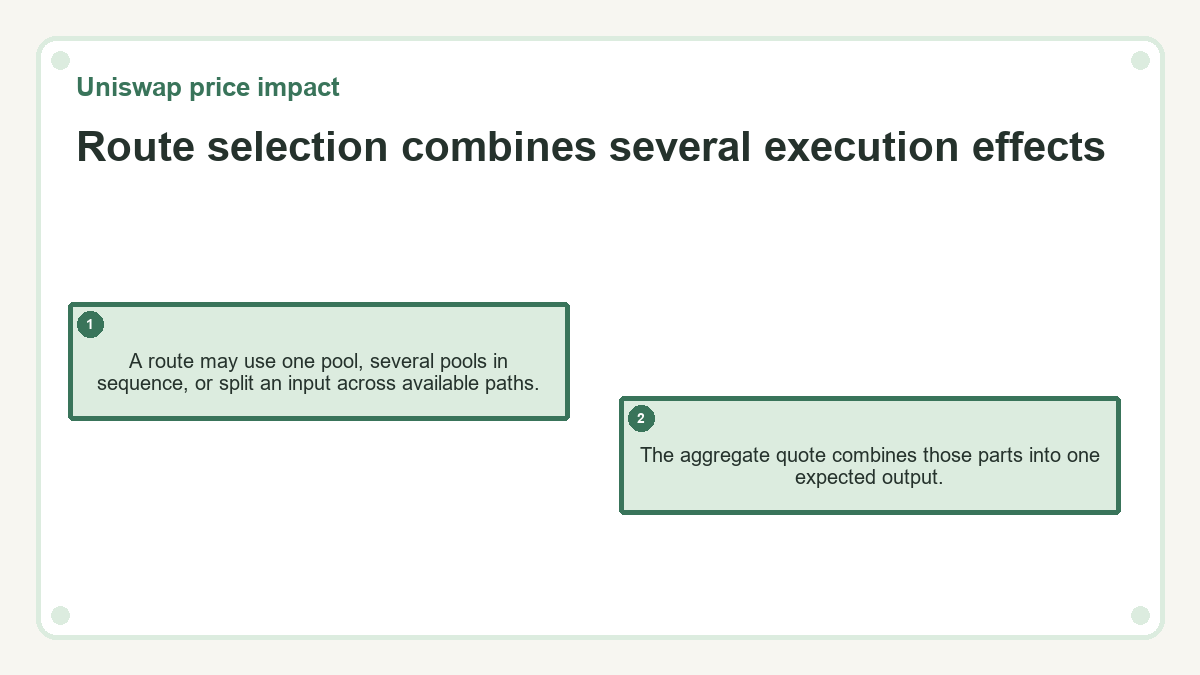
A route may use one pool, several pools in sequence, or split an input across available paths. The aggregate quote combines those parts into one expected output.
A direct pool path
One pool makes the source of curve movement easier to isolate. The output depends on the pool's current price, liquidity, and fee configuration. In a concentrated-liquidity pool, the active price range also matters.
A multi-pool or split path
Additional pools do not automatically make execution worse. Routing may accept extra legs when their combined liquidity produces a better estimate. Each leg can add a pool fee and move its pool's price. The relevant comparison is the complete quoted output and its attached minimum, not the number of pools alone.
Market movement begins after the quoted state snapshot
Price impact and later slippage describe different changes. The first belongs to the proposed trade under the state used for its quote. Slippage appears when execution encounters a different price or liquidity state. Another swap or delayed inclusion can create that difference; a route refresh can reveal it. A refreshed quote folds the new state into a new estimate, but it does not retroactively change what the earlier price-impact figure described.
Minimum output turns tolerance into a rejection boundary
For an exact-input pool swap, the simplified relationship is minimum output = quoted output × (1 - maximum slippage). Implementations work with integer token amounts, so token precision and rounding determine the encoded bound. The displayed minimum should therefore control the decision; hand arithmetic is a way to understand it, not a substitute for the submitted value.
A worked acceptance check for a pool route
All four changing values are hypothetical: a quote of 987.37 output-token units, a maximum slippage setting of 0.8%, a normal execution result of 981.24 units, and an edge-case result of 976.60 units. This case assumes an exact-input pool route exposes an adjustable slippage setting.
The simplified minimum is 987.37 × (1 - 0.008), which equals 979.47104 output-token units. Before token-specific rounding, that is about 979.47 units. The limit does not promise the original 987.37-unit quote. It rejects execution below the calculated floor.
If the route recomputes an output of 981.24 units, the transaction can satisfy this boundary because 981.24 exceeds 979.47. If changed liquidity produces 976.60 units, the output falls below the floor, so the swap must revert rather than settle at that amount.
An eligible UniswapX route follows a different control path. The adjustable setting used for non-UniswapX swaps does not apply there, so the displayed minimum amount becomes the relevant execution bound. If that route is unavailable, a pool route requires its own fresh quote and limit rather than reusing the order's figures.
Slippage tolerance changes acceptance rather than price impact
A wider tolerance lowers the acceptable output floor for a pool-routed exact-input swap. It does not deepen liquidity, improve the quote, or reduce the movement caused by the trade. A narrow setting rejects smaller adverse changes but may revert more often in a moving market. A wide setting permits a larger gap between quote and execution. The trade-off is rejection risk against the worst output the submitted bound allows.
Rejection conditions reveal which value actually failed
An output below the encoded minimum is one rejection cause, not a universal explanation for every failed swap. A transaction may also fail because its deadline passed, its allowance is insufficient, its balance changed, or another route-specific condition no longer holds. Raising slippage cannot repair those unrelated conditions.
Exact-output swaps reverse the protective direction. They target a specified output and limit the maximum input execution may spend. Treating their limit as a minimum-output figure produces the wrong comparison. Likewise, a quote error before submission is not an onchain minimum-output failure. The absence of an executable route or sufficient liquidity can prevent a valid estimate from being formed.
Retry evidence should identify the input that changed
A retry should begin with the failed action's final status. A pending transaction can still execute, so submitting another swap without resolving the first may create two live actions.
For a confirmed revert, inspect any available error information and the submitted parameters. The encoded minimum and deadline show which boundaries the transaction carried, even if the interface has already refreshed.
Next, compare a fresh quote with the earlier one. A lower estimated output, a different path, or a changed price-impact figure points to updated market or liquidity conditions. An unchanged quote shifts attention toward balance, allowance, deadline, or transaction-format problems.
A fresh quote also needs a fresh comparison between its rate and minimum output. Reusing an older minimum with a newer route joins two unrelated snapshots and says little about the new execution range.
Repeatedly widening tolerance is therefore a poor diagnostic method. It may allow a worse fill while leaving a missing authorization or expired deadline untouched. Change the input tied to the observed failure, then reassess the resulting quote.
The quoted rate and minimum output support different decisions
The quoted rate is a starting point for assessing the trade's expected execution quality. Price impact helps explain why that rate differs from the reference market price. If the quote is already unacceptable, a lower minimum does not improve it. Changing the amount, route, or timing may produce a different estimate, but each alternative requires a new comparison.
Minimum output answers a narrower question: how much deterioration may occur before execution must stop? Accepting a wider bound favors completion under changed conditions. Keeping a tighter bound favors rejection over a sufficiently worse fill. Compared with changing tolerance, changing the proposed trade addresses the quoted rate itself rather than merely broadening its acceptable outcome.
Before you start with Uniswap price impact
Does the price-impact percentage include the network fee?
No. Price impact describes the economic change in the swap's execution rate relative to a reference market price. The network fee pays for transaction processing and remains a separate cost. Pool fees can influence the quoted output, while the price-impact figure describes how the proposed trade moves through available liquidity. Compare these fields separately when judging the whole transaction.
Can splitting a swap lower total price impact?
Manually splitting one intended swap into smaller submissions can reduce the impact shown for each quote, but it does not guarantee a better combined result. Earlier parts change pool state before later parts, market conditions may move between submissions, and each onchain transaction can add another network cost. Compare the combined output and total costs of those submissions with one complete quote. An automatically split route is different because it presents one aggregate quote across its paths.
What makes a high-price-impact warning appear?
A high-price-impact warning appears when the estimated trade-caused price movement crosses the interface's warning logic. The displayed rate can change as the amount, route, or available liquidity changes, so the warning is tied to the current quote. It does not mean the network fee is high. It signals the quoted exchange result is far from the reference market price.
Is raising max slippage a way to reduce price impact?
No. Raising max slippage lowers the minimum output a pool-routed exact-input swap may accept; it does not change the liquidity curve or remove the trade's estimated impact. A broader tolerance may reduce reverts caused by intervening state changes, but it also permits a worse fill. Requote or adjust the proposed trade if its estimated execution rate is already unacceptable.
Can two routes with the same quoted output have different protections?
Yes. Two routes may display the same output estimate while using different liquidity sources, fees, transaction formats, or execution mechanisms. A pool route commonly applies a slippage tolerance to derive an output bound. An eligible UniswapX route displays its own minimum amount and does not use the non-UniswapX slippage setting. Read the bound attached to the selected route.
Is price impact paid to liquidity providers as a separate charge?
No. Price impact is not a separate amount transferred from the trader to liquidity providers. It is the less favorable average execution rate created as the swap moves along available liquidity. Pool fees are separate and form part of route economics. A quote can therefore reflect both pool fees and trade-caused price movement even though the interface labels them differently.